A practical six-question filter to help gym owners decide whether a new trend fits their core service. Learn how to protect your brand, keep strength training central, and avoid costly distractions.
Grow Your Gym Business: 6 Questions Every Fitness Business and Gym Owner Should Ask Before Chasing Trends
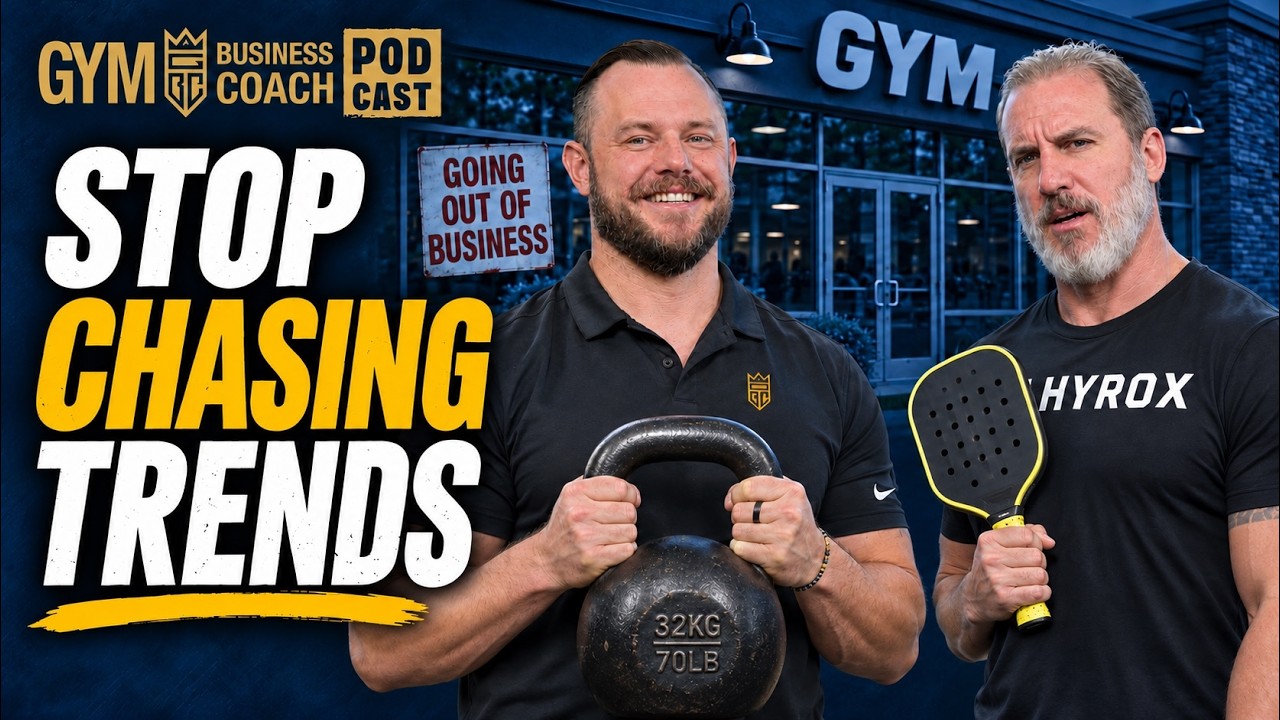
Table of Contents
- Welcome to Gym Business Coach
- When Fitness Trends Start Running Your Business
- Keep Strength Training at the Foundation
- How Constant Changes Confuse Your Market
- Is a New Trend Covering Up a Weak Core Service?
- Support Client Goals Without Rebranding Your Gym
- The Problem With Jumping From Trend to Trend
- The Six-Question Decision Filter
- Do You Believe in the Offer?
- Will It Get Clients Better Results?
- Can You Make Money With It?
- Can Your Team Sell It?
- Can You Deliver and Service It?
- Is It Within Your Scope?
- Build a Stronger Core Training Service
- Fix the Main Thing Before Adding More
- Capacity, Pricing, Staffing, and New Profit Centers
- Be the Best at What Your Gym Does
Welcome to Gym Business Coach
Your gym business does not need a new identity every time the fitness industry gets excited about something. If you run a fitness business, your job as a gym owner is to build something people trust, not chase every shiny object that rolls past your front door.
That sounds obvious. Then a new training format takes off, another owner starts talking about an extra revenue stream, and suddenly your perfectly reasonable plan gets replaced by, “Maybe we should do that.”
Maybe you should. But not because everybody else seems excited.
There is a big difference between adding something that makes your business better and grabbing something new because the business you already have is not working. One is a thoughtful decision. The other is a distraction with a price tag.
Before you buy equipment, change your programming, or put another name on your building, you need a way to separate the two. That is where these six questions come in.
When Fitness Trends Start Running Your Business
CrossFit. TRX. Kettlebells. Sandbags. HYROX. Pickleball. GLP-1 medications. The list keeps growing.
These are different things, obviously. A training tool is not a sport, and a sport is not a medication. But from a gym business perspective, they can create the same temptation, “This is the thing that will finally get us moving.”
Think back to when suspension training seemed to be everywhere. Entire facilities were built around frames with TRX straps hanging from them. The tool was not just part of the workout. It became the whole business.
There is nothing automatically wrong with a specialized offer. The problem starts when a gym owner keeps rebuilding around whatever happens to be popular next.
Today, you are this kind of gym. Tomorrow, you are that kind. Then another opportunity comes along, and everyone gets a fresh explanation of what you do now.
At some point, you have to ask who is running the fitness business: you, or the latest trend?
Keep Strength Training at the Foundation
Underneath a lot of these activities, the foundation looks pretty familiar: strength, muscular development, and power.
The packaging changes. The equipment changes. The event somebody wants to enter changes. But for the personal training businesses we work with, helping people get stronger remains central to the service.
That gives your gym business something solid to stand on.
You do not need to rebuild your identity every time a new use for strength becomes popular. You can keep delivering good training while helping clients apply it to the things they care about.
This is not an argument for ignoring everything new. It is an argument for knowing what stays put.
A kettlebell can be a tool inside your training program. It does not have to become your entire personality. The same goes for suspension training, sandbags, or preparation for a particular competition.
When the foundation is clear, a new idea has to support it. The foundation does not move just because the idea is exciting.
How Constant Changes Confuse Your Market
Every time you change what your gym stands for, you ask people to figure you out again.
You put CrossFit on the door. Then you take it off. You become a HYROX training facility. Then clients struggle to get into the race, you get frustrated, and suddenly you are not doing that anymore either.
Meanwhile, what happened to the main thing?
A gym owner may experience those decisions as separate opportunities. From the outside, they can look like a business that cannot decide what it is.
That matters because your identity is not just a sign. It is the answer to a basic question, Why should somebody come here?
If the answer changes constantly, your market has to keep relearning it. Your coaches also have to explain the latest version, and your clients have to understand where they fit.
A fitness business can evolve without becoming unrecognizable. But changing direction is not automatically progress. Sometimes you are just making it harder for people to understand the good service you already offer.
Is a New Trend Covering Up a Weak Core Service?
Here is the uncomfortable question: why does this new thing look so attractive right now?
Is it genuinely a good fit? Or are you struggling to bring in clients for your main service, and this feels easier than fixing that problem?
A new offer can feel productive. There is something to announce, something to buy, and something different to talk about. Working on the quality of your training or your ability to sell it is usually less exciting.
It is also harder to avoid.
If your gym business cannot consistently attract clients for the service it was built to provide, adding another service does not answer why. You may simply carry the same problems into a bigger, messier menu.
Ask yourself:
- Are we confident in the training we deliver?
- Can we clearly explain why someone should choose us?
- Can we sell our main service consistently?
- Are we looking for an addition, or an escape?
Be honest. A gym owner who recognizes a weak foundation can strengthen it. An owner who keeps covering it with new offers stays busy without necessarily getting anywhere.
Support Client Goals Without Rebranding Your Gym
Suppose some of your clients want to enter a HYROX event. Great. Can you help them prepare through the training you already provide?
That is a different question from, “Should we turn the whole place into a HYROX gym?”
You can support a goal without handing over your business identity to it. You can take a client's interests seriously without making those interests the new direction for every coach and client in the building.
The same thinking applies when people get excited about pickleball or another activity. Start with what they need from their training. Then decide how that fits what you do.
That approach keeps the client at the center. A full rebrand can put the trend at the center instead.
For a gym owner, the distinction is important. Helping a group of clients pursue something is a service decision. Attaching your whole fitness business to that thing is a much bigger commitment.
You do not need a new sign every time a client gets a new goal.
The Problem With Jumping From Trend to Trend
You have probably seen the online personality who seems to become an expert in a new money-making opportunity every few months.
First it is crypto. Then foreign exchange trading. Then stocks. Then real estate. Same person, fresh claim to expertise.
It is easy to roll your eyes. How are they suddenly the authority on all of it?
Now turn that question around. What does your gym business look like when it keeps jumping from one hot offer to another?
That comparison stings a little, but it is worth making. You might dislike the behavior online while doing a version of it inside your own facility.
There is also a practical cost. Each change requires your attention, your team's attention, and another attempt to build momentum. Just as people start understanding the offer, you switch tracks again.
Worse, you may not even believe in every new thing you introduce. You just believe it might sell.
That is a shaky place to build a fitness business. Which brings us to the filter.
The Six-Question Decision Filter
Before we seriously consider a new product, service, or training offer, it has to get through six questions:
- Do we believe in it?
- Will it get our clients better results?
- Can we make money with it?
- Can we sell it?
- Can we deliver and service it?
- Is it within our scope?
Every answer must be yes. One no is enough to stop.
This is not a scoring system where five out of six earns a passing grade. A profitable offer that you cannot deliver is still a problem. Something you love but cannot sell is still a problem.
And six yeses do not mean you launch it next Monday.
They mean the idea has earned further consideration. You can then work through what it would actually look like inside your gym business.
The purpose is to help a gym owner say no to more things, not create a clever excuse to say yes. Opportunities show up constantly. Your attention, staff, and capacity do not expand just because another one sounds promising.
Do You Believe in the Offer?
Start here, not with the money.
Do you believe in the product, service, or training method? Would you feel good putting your business behind it?
If the honest answ...[truncated]
Continue learning
Pricing and Profitability
Explore more Gym Business Coach strategies on this operating topic.
Explore this topic →
GYM BUSINESS COACH TEAM
The Gym Business Coach Team helps gym owners build more profitable, scalable businesses through coaching, masterminds, and live events. 2,700+ gym owners coached across North America. Learn more at ironcircle.net.