Stop spinning with AI tools that keep you busy. Learn how to audit tasks, automate what matters, and reclaim time to coach and grow your gym.
AI in Your Gym Business: Is It Helping Your Fitness Business or Keeping You Busy as a Gym Owner?
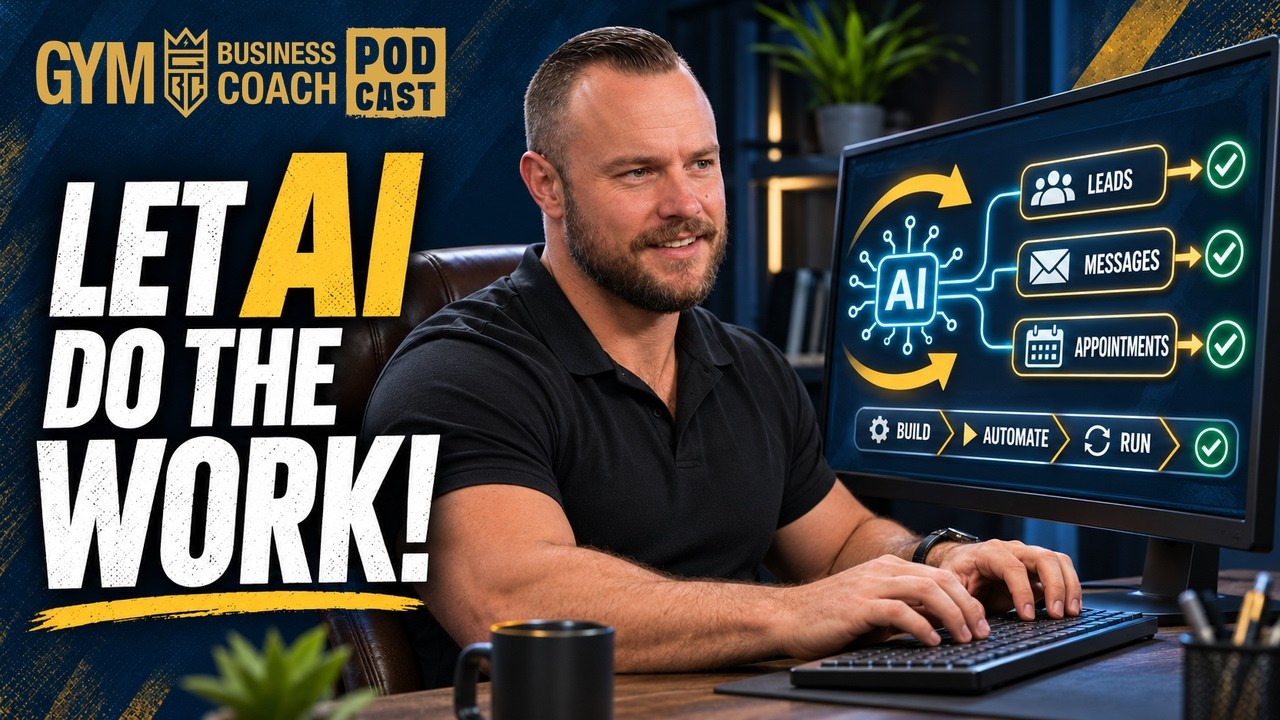
Table of Contents
- Welcome to Gym Business Coach
- AI for Gym Owners: Helpful Tool or Distraction?
- Should You Use AI for Workout Programming?
- Audit Your Daily Tasks Before Automating
- An AI Appointment-Scheduling Example
- Solve the Problem, Not Just the Symptom
- When AI Workout Tools Become a Band-Aid
- Email Workflows and the Copy-and-Paste Trap
- Is AI Actually Helping You Do Less Work?
- Eliminate, Automate, Delegate
- The Manual Loop in AI Workout Programming
- Outcomes Over Effort
- Just Because You Can Build It Doesn’t Mean You Should
- Make Your Gym Better, Not Just Busier
- The Entrepreneur’s AI Slot Machine
- Start With the Outcome You Want
- Semi Private Pro and Final Takeaways
Welcome to Gym Business Coach
Your gym business does not need more things to keep you occupied. Your fitness business needs better results. And as a gym owner, you need to know the difference before AI becomes another job you accidentally give yourself.
AI can do some incredible things. It can help with scheduling, communication, workout programming, and repetitive tasks that eat up your attention. We use it. We teach it. This is not an argument for pretending it does not exist.
But there is a question that gets lost in all the excitement: Is this actually getting work off your plate, or are you just doing the same work with a cooler tool?
If you still have to start every process, move information around, check the output, and repeat the whole thing next month, you may have made a task faster. That is useful. But it is not the same as building a business that depends less on you.
That distinction matters. Especially when the new tool is interesting enough to swallow your entire afternoon.
AI for Gym Owners: Helpful Tool or Distraction?
We recently ran an AI workshop for gym owners, and the opportunity is real. There are tasks inside a fitness business that can be handled with far less manual involvement than most owners realize.
There is also a slippery slope. You discover what AI can do, start experimenting, and suddenly you are building little tools for everything. It feels productive because things keep appearing on the screen.
But activity is not automatically progress. A gym owner can spend hours building an impressive process that does not improve the business in any meaningful way.
Maybe it still needs you every time. Maybe it helps complete a task that should not exist anymore. Maybe it solves the annoying part of a broken process without fixing the process itself.
The guardrail is simple: Judge AI by the business outcome, not by how impressive the output looks.
Does it remove repeated work? Reduce interruptions? Help your team serve clients? Give you time back for higher value responsibilities?
If yes, great. If not, you might have found an entertaining distraction. Nothing wrong with enjoying new technology. Just do not confuse that enjoyment with improving your gym business.
Should You Use AI for Workout Programming?
Workout programming is one of the most common places gym owners are trying AI. The pitch sounds good: teach it your methodology, give it client information, and have it generate personalized programs.
Can AI help with that? Sure. But whether it can write a workout is not the most important question.
The better question is whether your programming system still requires the same recurring work.
If every new client creates another round of data entry, prompting, reviewing, transferring, and updating, you still have a manual system. AI is just participating in it.
That may be an improvement over writing everything from scratch. But do not stop the evaluation there. Compare it with a process where your training methodology is already built, and coaches customize the work while coaching the client.
A fitness business needs programming that supports its service model. It does not need a complicated writing process simply because that process now includes AI.
Before choosing a tool, look at the full cycle. What happens when someone joins? What happens during sessions? What happens when their program needs to change? That is where the real workload lives.
Audit Your Daily Tasks Before Automating
When we worked through AI use cases with our directors, we started with an audit. Not a shopping list of software. An honest look at what they actually did all day.
The assignment was straightforward: document your tasks as you go. You could talk into ChatGPT and explain what you were doing that morning, what had interrupted you, or what you had just finished.
We created an AI assistant to flag activities that might be handled by an agent or a group of agents. The point was to find real work worth removing, rather than invent work for a new tool.
For a gym owner, that audit can expose patterns you barely notice anymore:
- Answering the same scheduling questions.
- Moving information between systems.
- Drafting similar email replies.
- Rebuilding client programs through the same sequence of steps.
Those tasks can feel small individually. Together, they explain why you are constantly busy.
But spotting a repeated task is only the beginning. Before automating it, ask whether it needs to happen at all. Otherwise, your gym business could get very efficient at doing unnecessary work.
An AI Appointment-Scheduling Example
Here is a practical example from that audit. A member sends a message asking whether they can train at 8 a.m.
You stop what you are doing, open the schedule, check availability, reply, and book the appointment. Maybe that takes a minute. The bigger issue is that it interrupts whatever you were focused on.
An AI agent connected to your scheduling system could handle that sequence. In a suitable setup, it could check availability, prepare a response, request approval where needed, and book the appointment.
We discussed scheduling platforms such as WellnessLiving and Mindbody as examples of where that information might live. The actual setup depends on the system and access available. Simply opening a chatbot does not connect it to your calendar.
The useful part is the complete workflow:
- Receive the member's request.
- Check the schedule.
- Confirm an available appointment.
- Handle the response and booking with the appropriate approval.
Now the gym owner is not manually carrying information through every step. That is a more meaningful improvement than having AI write a friendly booking reply while you still do everything else.
Solve the Problem, Not Just the Symptom
There was one big rule around the audit: Do not build an automated process for a symptom when you could solve the underlying problem.
Go back to scheduling. If members already have an app and occasionally ask for help, an agent might be useful. You are handling an exception inside an otherwise workable system.
But suppose members constantly text because they have no way to book their own appointments. Now the issue is different.
You could build an AI assistant to process all those messages. Or you could give members access to a schedule where they can book themselves.
The first option makes the existing process faster. The second changes why the work shows up in the first place.
That is a critical distinction for any fitness business. When a task keeps returning, ask:
- Does this process genuinely need to exist?
- Is this an occasional exception or the normal way we operate?
- Could a better system prevent the request altogether?
AI can make a workaround look sophisticated. It is still a workaround. Fixing the source of the work usually deserves consideration before building a faster way to handle it.
When AI Workout Tools Become a Band-Aid
We came across a programming software feature that could turn a photo of a handwritten workout into a workout inside the platform.
You could write it on paper or a whiteboard, take a picture, and have the software enter it for you. Technically, that is pretty cool.
But look at what still happened: someone had to design and write the workout first.
The feature removed some typing. It did not remove the programming work. That is why we called it a flashy band-aid.
If typing workouts into software is your specific problem, the feature addresses part of it. But if your actual goal is to stop repeatedly designing and entering programs, it does not get you there.
This is where a gym owner needs to separate a useful feature from a better operating model. Those are not automatically the same thing.
For semi-private training, our approach with Semi Private Pro is to build the programming methodology into the system, then have coaches scale and score clients on the training floor.
The comparison is not simply handwriting versus photography. It is repeated workout creation versus a programming system designed to avoid that repeated creation.
Email Workflows and the Copy-and-Paste Trap
Email is another place where AI can make you feel more efficient while leaving you in the middle of everything.
You receive a message. You read it. You copy it into ChatGPT or Claude. You add a few sentences explaining how you want to respond. Then you copy the draft back into your inbox, review it, and send it.
Yes, the writing may be faster. But you are still moving the information throug...[truncated]
Continue learning
Pricing and Profitability
Explore more Gym Business Coach strategies on this operating topic.
Explore this topic →
GYM BUSINESS COACH TEAM
The Gym Business Coach Team helps gym owners build more profitable, scalable businesses through coaching, masterminds, and live events. 2,700+ gym owners coached across North America. Learn more at ironcircle.net.