Most gym problems stem from the product, not marketing. This post shows how to upgrade your offering to boost retention, referrals, and staff morale.
Gym Business Problems Have One Root Cause: Your Product
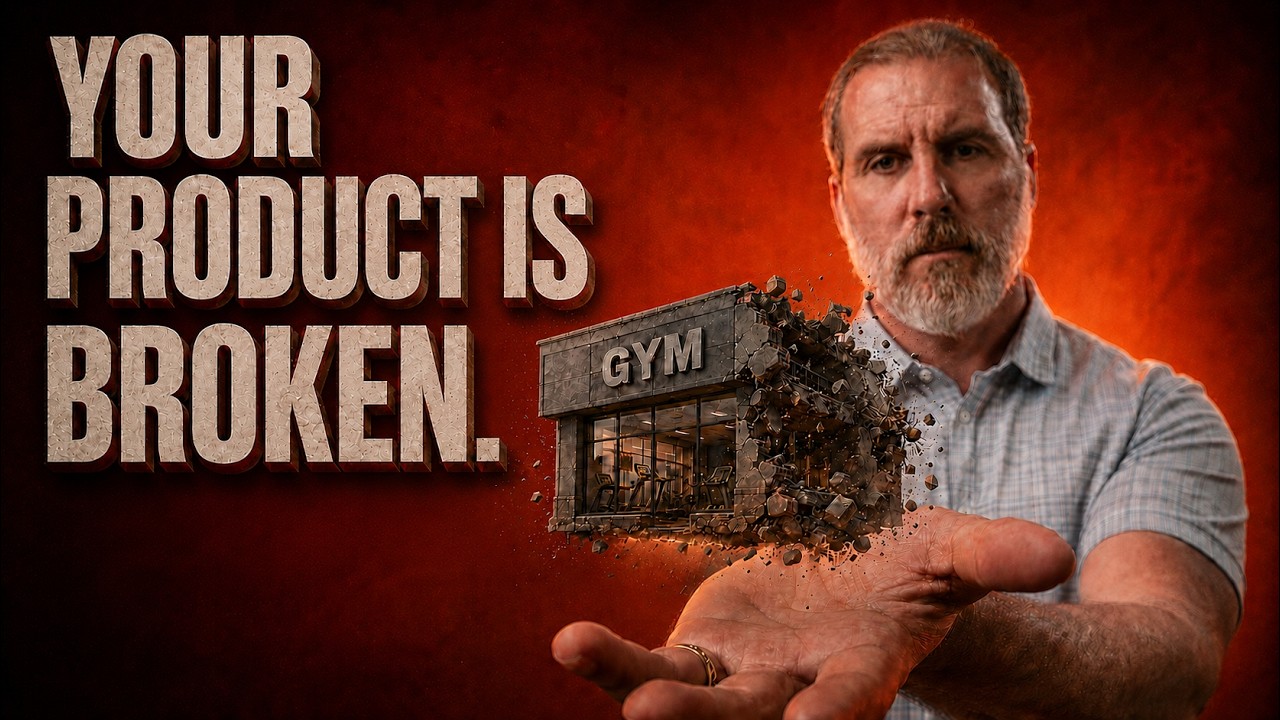
Table of Contents
- Welcome to the Gym Business Coach Podcast
- The 3 Biggest Problems Gym Owners Face
- Why the Product Is the Root Cause
- Why Generic WODs Hurt Your Gym
- Raise the Standard of Your Product
- The Training Floor Wake-Up Call
- What Happens When the Product Improves
- Personalized Programming at Scale
- The Fourth Model in Action
- Why Early Adopters Win
- Stop Copying Your Competitors
- Learn the Fourth Model
- Final Takeaways
Welcome to the Gym Business Coach Podcast
If you own a gym business, there is a decent chance you have spent time worrying about marketing, staffing, lead generation, cancellations, sales, and the usual list of fires that seem to pop up every Monday morning.
Maybe you are asking: How do I get more leads? Why are people leaving? Why can’t I keep coaches longer than a year or two? Why does every month feel like I am refilling a bucket with a hole in the bottom?
Those are real problems. But most of the time, they are not the original problem.
For a lot of gym owners, client acquisition, staff turnover, and member retention are symptoms. The root cause is simpler, harder to admit, and way more important:
The product is not good enough yet.
That does not mean you are a bad coach. It does not mean your team does not care. It does not mean the gym is failing. It means there is likely room to make the experience on the training floor more valuable, more personal, more visible, and more difficult for competitors to copy.
A great fitness business is not built by putting a better ad in front of the same old product. It is built by creating an experience people want to stay with, talk about, and pay more for.
The 3 Biggest Problems Gym Owners Face
After coaching and speaking with thousands of gym owners over more than a decade, the same three issues show up again and again.
- Client acquisition: You need more people walking through the door and signing up.
- Staff retention: Coaches leave too soon, and replacing them becomes exhausting.
- Client retention: Members cancel, drift away, or never stay long enough to build a true long-term relationship with your gym.
Every gym owner feels these problems differently. A newer facility might be desperate for leads. A larger operation may be more concerned with team turnover. Another gym business might be technically profitable but constantly losing members and scrambling to replace them.
Still, the pattern is pretty consistent. When clients do not stay, referrals stay low. When referrals stay low, marketing feels harder. When the service is frustrating or unclear, coaches feel more pressure and less pride in their work. Then they leave, and the cycle starts all over again.
It is tempting to treat each issue separately.
- Buy more leads to solve client acquisition.
- Offer another raise to solve staff turnover.
- Run a win-back campaign to solve cancellations.
Those things might help at the edges. But if the product itself is weak, generic, or hard to see value in, you are mostly putting bandages on the symptoms.
And bandages are fine for a paper cut. They are not much help when the roof is missing.
Why the Product Is the Root Cause
When we say “product,” we do not just mean the workout.
Your product is the entire thing a client receives after joining your gym business. It includes the programming, the coaching, the way a coach delivers that programming, the condition of the facility, the equipment, the cleanliness, the schedule, the price, and the overall experience on the floor.
Your coaches are part of the product too. They are the people delivering the service. Their ability to confidently guide clients matters. Their workload matters. Their stress level matters. Whether they feel proud of what they are delivering matters.
So when a gym owner says, “Our product is great,” it is worth slowing down for a second.
If clients leave quickly, coaches leave regularly, and signing people up is always a grind, there is probably something worth examining. Not because everything is broken, but because the market is giving you feedback.
The smartest gym owners do not assume they have reached the top of the mountain. They keep asking better questions:
- Is this the best experience we can deliver?
- Can clients clearly see what they are paying for?
- Are coaches equipped to do great work without unnecessary stress?
- Does our product feel different from what is down the street?
- Would a client describe this as personal, premium, and valuable?
A gym business can be good and still have room to become dramatically better. In fact, that mindset is usually the difference between a business that levels off and a business that keeps growing.
The goal is not perfection. The goal is getting one percent better, then doing it again. Every day. Every week. Every year.
Why Generic WODs Hurt Your Gym
Here is one of the biggest issues in the fitness business: the generic workout of the day.
There is a whiteboard or chalkboard. A group of people walks in. Everyone sees the same workout. Then everyone is expected to make that workout fit, even though they are completely different human beings with different bodies, goals, histories, strengths, weaknesses, and limitations.
One person may be young and athletic. Another might be older and returning after years away from exercise. One client may be strong but dealing with an injury. Another may need to lose weight, move better, and build basic confidence. One might want performance. Another might just want to get through the day without feeling beat up.
Yet they are all standing in front of the same board.
Sure, a coach can scale it. The load can be lighter. The distance can be shorter. The movement can be modified. Those adjustments are common, and they have their place.
But there is a bigger question a gym owner has to answer honestly:
Is that the best possible product, or is it simply the easiest way to get everyone through the hour?
That question can sting a little. It should.
Most coaches would agree that a program built around an individual’s movement quality, goals, capacity, and needs is better than a generic WOD. If every client could receive training that was actually designed around them, it would be a higher-level product.
The argument against it is usually not that it is worse. The argument is that it is difficult.
And that is fair. Personalized programming for every person is harder than writing one workout on a board. It takes a better system. It takes better delivery. It takes a way to provide individual attention at scale.
But difficulty does not make it unimportant. It just means the gym business that figures it out has an advantage.
A client may not know all the programming theory behind the scenes. But they know whether the service feels like it was made for them. They know whether they are being coached with intention. They know when the person next to them has exactly the same plan despite having completely different needs.
And eventually, they start asking themselves a quiet question: “What exactly am I paying for?”
Raise the Standard of Your Product
Most gym owners do not need to be told that individualization is better. They already know it.
The real issue is whether they are willing to raise the standard of what they deliver.
It is easy to defend the current model because it is familiar. It is easy to say there are only so many ways the human body moves. It is easy to point out that a good coach can modify a workout on the fly.
All true. None of it changes the fact that there are levels above a generic product.
If you could remove the operational headaches, the programming challenge, and the concern about scale, would you give every client a program that better matched their goals and movement quality?
Most people would say yes.
That answer tells you everything you need to know. There is a better version of your product available. The question is whether your gym business will do the work required to build it.
Premium does not mean fancy for the sake of fancy. It means the service has a higher level of care, clarity, and value. It means the product is visible. Clients can understand their path. They can see that their training is not random. They can recognize that their experience is different from the usual one-size-fits-all group class.
That is what makes a fitness business harder to compare on price.
The Training Floor Wake-Up Call
Sometimes the best thing a gym owner can do is stop staring at reports, stop refreshing the lead dashboard, and spend an hour quietly observing the training floor.
Not as the owner who is trying to defend every decision. Not as the coach who knows why everything happens the way it happens. Just observe it like a client would.
Watch what people are doing.
Look for the pauses. Look for confusion. Look for people waiting around. Notice whether clients appear to have a clear direction. Notice whether coaches are stretched thin. Notice whether the whole thing feels organized and intentional, or whether it feels like everyone is just trying to survive the hour.
That kind of observation can be a wake-up call.
There was a moment when the training floor was viewed from behind a two-way mirror for about an hour. The lights were off, and the whole operation was visible without anyone changing behavior because the owner was standing there.
What showed up was not a disaster. It was something more useful: evidence that the client experience could be much better.
People were waiting. There were struggles that had become normal. Coaches were doing things because that was how they had always been done. The floor did not reflect the quality of product...
Continue learning
Leads and Sales
Explore more Gym Business Coach strategies on this operating topic.
Explore this topic →
GYM BUSINESS COACH TEAM
The Gym Business Coach Team helps gym owners build more profitable, scalable businesses through coaching, masterminds, and live events. 2,700+ gym owners coached across North America. Learn more at ironcircle.net.