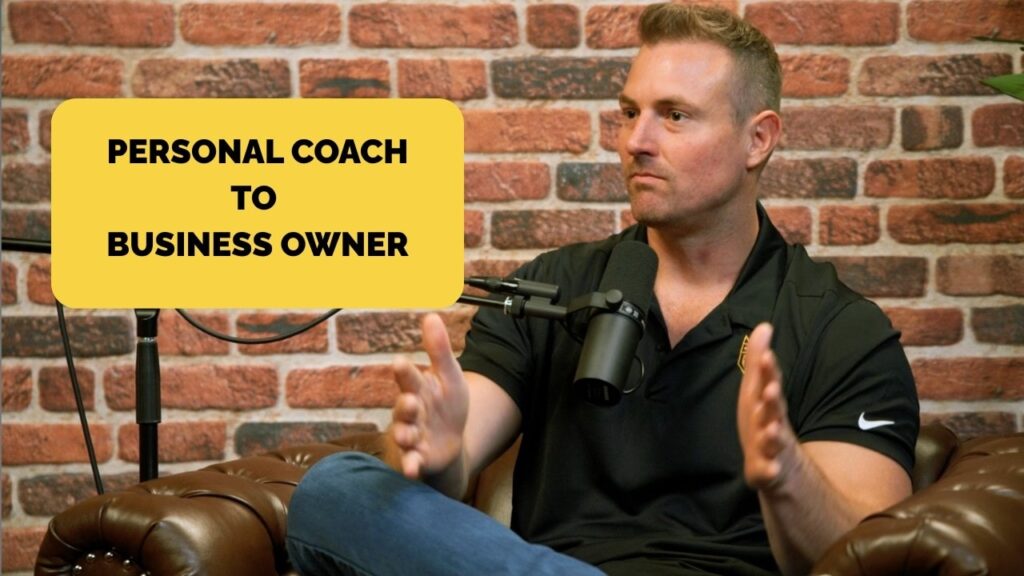
If you're a gym business owner, or you're trying to become one, you probably already know the "job description" part. You coach people. You run sessions. You care about programming and results and form. But what you might not realize is this: your gym owner identity changes in phases. And if you do
If you're a gym business owner, or you're trying to become one, you probably already know the "job description" part. You coach people. You run sessions. You care about programming and results and form.
But what you might not realize is this: your gym owner identity changes in phases. And if you do not adapt, you end up stuck doing technician work while building something that will never become a true fitness business.
This is the story of that journey. From the big-box gym trainer beginnings to the independent trainer stage, then into the real responsibilities of facility ownership. And finally, the part most people avoid thinking about until it's suddenly urgent: your exit goal.
Table of Contents
- Start as a trainer. Stay a trainer too long. That is the whole trap.
- The second phase: going independent changes everything (even if you feel "free")
- The identity shift: gym owner becomes a different kind of adult
- The technician trap: why "more training knowledge" sometimes means less growth
- Owner maturity: build the system, then let your coaches do the work
- Know your numbers: the metrics that keep your fitness business honest
- Cash flowing operation versus exit goal: the endgame changes you
- Burnout warning signs: when ownership stops being fun
- Exit paths: shutdown, take over, or sale (and why "pass the torch" is often best)
- What gym owners should do next, depending on where they are
- One last truth: your "why" will evolve. Plan for it
- Ready to shift from technician to business operator?
Start as a trainer. Stay a trainer too long. That is the whole trap.
Most gym owners start as trainers because they love fitness. They like learning exercises. They like the human body. They like tinkering with techniques and figuring out what works for who.
They think, "I can turn my passion into a paycheck." Which is honestly a great start.
Then reality hits.
The big-box gym reality: you are not just a coach, you are also a salesperson
In a big-box gym, you often start with the purest fantasy. The idea that clients are just going to show up and you will train them. But in many cases, the first week on the job looks more like:
- Walk the floor
- Talk to members
- Sell a free training session or orientation
- Then sell a package
It's not always taught in a friendly way, and it definitely isn't what people expect when they first enter the industry. But it matters because training does not create revenue on its own. Sales and marketing do.
That is why so many trainers burn out early. Not because they lack heart. Because they got trained as technicians, but they were dropped into a sales role.
"Orientation grind" is not a small detail. It shapes your whole life.
Here's what the orientation pipeline can look like in a big-box setting: you sell or schedule consultations, and many people do not show up because it is free. Sometimes it is a 70 percent no-show situation.
So your day becomes chaotic. You might get a couple sessions back to back, then a long stretch of waiting, then maybe one orientation shows up, then back to training. Meanwhile, your training time might only be four or five hours out of a brutal 12 to 14 hour day.
And when the environment is a big box, there are also distractions. Watercooler energy. Random downtime. Employees everywhere means more "life" happening between tasks.
So you end up thinking, "How do I make this livable without becoming miserable?" That's the real question you face in the trainer phase.
The second phase: going independent changes everything (even if you feel "free")
Once you get good at getting clients and generating revenue, many trainers naturally look toward independence. They start thinking, "If I do this on my own, I will keep more of the money."
And that logic makes sense. In a big-box gym, you are usually taking a small percentage of revenue. The company keeps the majority. If you are doing the work, it feels wrong.
Renting space: the next step for many, and the ceiling for some
A common progression is renting space inside a facility or building a private setup where the trainer controls the client relationship.
But independence comes with a new problem that does not feel obvious at first:
- You lose the ocean of prospects.
- You cannot rely on the facility's marketing anymore.
- People who walk into a "trainer lease" gym are often already loyal to someone.
So now you have to attract people using your own efforts:
- Referrals
- Grassroots networking
- Influencer-style marketing (social media, short videos, consistent content)
- Community presence
At this stage, the revenue equation changes from "I train" to "I create." If you do not create, you do not eat. That mindset shift is huge.
Important advice: do not confuse ownership with obligation
Some trainers stop at renting space. Others push forward into opening their own gym.
Here's the coaching truth that saves people years: if you do not want the full job of ownership, you should not take the liabilities of ownership.
It's easy to hear "owning your own facility" and think it is the dream. But when you open a gym you inherit:
- A lease
- Equipment costs (often financed)
- Insurance
- Legal responsibilities
- Marketing that actually produces leads
- Staffing issues when you finally hire
Many people are still "the technician" at this stage. They are training clients, maybe doing consultations, marketing, referrals, check-ins. They are still the face of the business.
But the business becomes something different than what they expected. More obligation. More responsibility. Less ability to hide inside coaching.
And if the goal was just to keep more training revenue and not deal with overhead, the lease can feel like a punch in the gut.
The identity shift: gym owner becomes a different kind of adult
There's a funny way the industry talks about growth. People focus on the newest exercise, the newest gadget, the newest "must add" training protocol.
But ownership growth is about maturity. Not in some cheesy "believe in yourself" way. In a practical, responsibility way.
Your gym owner identity evolves like priorities evolve in life.
Think "adolescent brain" versus "adult brain" in gym ownership
When you are a young trainer, you care about what happens on the floor. Form. Variations. Better programming. New techniques.
When you become a gym owner, that matters, but it should not be your main obsession.
In the early ownership phase, it can feel like your identity gets stuck in the adolescent version of business. You still wake up thinking about training mechanics and new exercise prep, but you now also have:
- leads to generate
- staff to manage
- systems to build
- numbers to track
- and the constant question: "How do I make this thing profitable?"
If you keep treating ownership like continuing education for training, growth hits a ceiling.
Training is your brand. But you do not have to micromanage it
Let's be clear. The training is still the brand. That is the thing that cannot be faked long-term.
But your job as an owner is not to be hands-on 24/7. Your job is to create a system where the training quality stays consistent without you spending your life doing it all.
When you do this right, you shift from being a technician to being a leader.
The technician trap: why "more training knowledge" sometimes means less growth
Training education is valuable. But there's a difference between improving your coaching and improving your gym business.
Many gym owners attend workshops, get certifications, and collect credentials like they're rare Pokémon. Meanwhile the business does not move.
Because certifications and workshops do not automatically bring customers into your door.
Marketing and selling do. Business systems do.
Real-world pattern: owners don't know their numbers (and that is a problem)
Over the years, the coach behind this podcast has talked with thousands of gym owners. He describes a moment that repeats often: a new gym owner is asked about their P&L, and they respond like "What's a P&L?"
That might sound harsh, but it points at the real issue. Gym ownership has no guide in the usual "certificate" curriculum. You get training education, but business education often comes late, or not at all.
And without business fluency, you cannot diagnose what is limiting growth.
You can work hard and still grow slowly. Sometimes slower than you should. Sometimes you can even create a "successful" gym that traps you because it never becomes predictable and scalable.
What to focus on instead of constant training CE
Here's the shift: start spending your learning time on the stuff that creates revenue and stabilizes your operations.
That includes things like:
- lead generation systems
- sales process improvements
- client onboarding and retention
- staff training and accountability
- reliable scheduling and programming workflows
- financial tracking and decision-making
Even if the business is already good, this is what makes it scalable.
Owner maturity: build the system, then let your coaches do the work
Once you reach the point where your gym business is stable enough to hire coaches, your role should change.
You become the orchestrator. Not the main technician.
Two different brains: the trainer brain versus the owner brain
The trainer brain can get lost in programming. It wants to be in flow state. It wants to design the perfect session.
That is great. But it does not directly create revenue by itself.
The owner brain asks different questions:
- How do we create a programming system anyone can run?
- How do we reduce friction and increase consistency?
- How do we train staff so quality stays intact?
- How do we build repeatable outcomes for clients?
- How do we create freedom instead of a second job inside your job?
If you never build systems, you eventually get jaded.
Because then programming becomes a Sunday night stress. You are not doing it because you love it. You are doing it because the business depends on you personally. That's a fast track to resentment.
How systems protect your lifestyle
Systems are not "corporate" or "cold." Systems are what prevent your life from being consumed by your gym.
When programming, sales, and onboarding are structured, your team can execute. You can oversee, adjust, and improve, but you are not stuck doing everything at midnight.
And your coaches stop feeling like they are winging it. They can do their jobs confidently.
Know your numbers: the metrics that keep your fitness business honest
If you want your gym to grow beyond your personal effort, you need visibility. Not motivation. Visibility.
Gym owners often track what feels easy: revenue, maybe attendance, maybe how busy the gym looks on a random day.
But the numbers that actually matter are the ones that tell you:
- How leads convert
- How many clients you retain
- Whether onboarding is working
- What your capacity is and how it fills
- Where your profit really comes from after expenses
Because if you do not know those inputs, you can accidentally spend a ton of time trying to "optimize" training while revenue is the real bottleneck.
And if you do not know your costs, you can also end up with that painful situation where the gym is technically "making money" but you still cannot afford your life.
Cash flowing operation versus exit goal: the endgame changes you
At some point, a gym owner becomes a real owner. The business is functioning. The team runs things. Clients get coached. Systems exist. Profit is predictable enough to breathe.
Then a new question shows up:
"What do I want my life to look like because of this gym business?"
Two common paths: keep it cash flowing or sell and move on
There are a couple of typical endgames.
One path is the cash flowing model. The owner keeps the business, gets owner benefit, pays a salary, and reaps the rewards.
The other path is an exit goal. This is the "cash out" or "sell to retire" scenario. Not a cash grab. A real transition.
Most people think selling means "passive income." It often means "new life"
There is no fully passive income. Even if you sell, you still need to be a human. You still need purpose.
Many owners who sell to retire end up feeling bored within a year. They miss the challenge. They miss learning. They miss being around something with a pulse.
So a lot of owners sell with the intent to retire, then realize they do not actually want retirement. They want the next challenge.
Skill sets travel. That matters more than people admit
Gym ownership teaches hard skills. Marketing. Selling. Building systems. Hiring and managing. Financial decision-making.
Those skills transfer to other industries. Sometimes you hear gym owners talk about how other business models feel "easier" because the product is easier to sell.
For example, a nail salon sells something people already want right now. A training gym sells delayed gratification: hard work now for results later. That is a tougher sale, and it forces you to build better systems and stronger trust.
So when gym owners take those skills elsewhere, they often feel like they unlocked a cheat code. They did not just learn fitness. They learned business fundamentals.
Define your lifestyle first. Retro it with your business plan.
One of the more grounded pieces of advice in this ownership phase is to define the lifestyle you want, then design the business to support it.
Not the other way around. Because if you design the business to maximize training hours, you end up with the kind of ownership that feels like obligation instead of joy.
Burnout warning signs: when ownership stops being fun
You can tell a lot about your gym business based on how you feel doing the work.
At the beginning, you can work crazy hours because it is exciting. You are building. You are learning. You believe your effort matters.
Then something changes.
You start knowing what needs to get done, and you feel resentment. You know how to do it, but you do not want to do it. It starts feeling heavier.
That is a warning sign.
It might mean burnout. It might mean the business is stuck at the technician stage. Or it might mean you have outgrown your current role.
Here's the key mindset: this does not mean you failed
Feeling stuck does not mean you picked the wrong path. It usually means you need the next step.
Sometimes that next step is skill up. Sometimes it is hiring and building systems. Sometimes it is restructuring your role. Sometimes it is an exit conversation.
Whatever it is, do not stay trapped in "same life, different day" mode.
Exit paths: shutdown, take over, or sale (and why "pass the torch" is often best)
Let's talk about what most gym owners think about only when it becomes emotional: exiting.
Most exit conversations boil down to a few common outcomes.
Option 1: shut it down
This is the most common "simple" answer. Close the doors and end it.
People do not always want this outcome, but it happens when the business is not dialed in for succession or sale. It can also happen when owners lose interest or get burned out without building what would be sellable.
Option 2: internal takeover
The next most common exit is handing the business to someone already inside it. A coach. A trusted operator. A successor who understands your systems and culture.
This is often the most logical path because you can pass knowledge, processes, and client relationships with less disruption.
In other words, you pass the torch.
Option 3: sell it on the market
You can sell the gym, but selling well requires the business to be dialed in.
If everything is held together by your personal effort, buyers do not trust the longevity. They worry the business collapses when you are gone.
For a clean sale, you need systems, documentation, staff capability, and stable financial performance.
Why "exit well" requires earlier preparation
This is why planning your endgame matters long before you want to exit.
If you wait until you are tired, you often do not have time to rebuild the machine into something sellable or handoff-friendly.
The gym owner journey is not just about building a place to train. It's about building a business that can outlive its founder.
What gym owners should do next, depending on where they are
Not everyone is at the same stage. So here's a simple way to think about your next step.
If you are still a trainer, focus on the business side of sales and retention
You do not need to abandon coaching. You need to stop ignoring what creates the pipeline.
- Learn how leads convert into memberships
- Understand basic P&L concepts
- Improve your onboarding experience
- Track retention and referrals
If you are independent, sharpen marketing and client acquisition systems
Independence requires you to create your own demand. Referrals help, but they are not always enough.
- Build a repeatable referral engine
- Create a simple content strategy that attracts the right people
- Work on conversion, not just training sessions
If you own a facility, stop being the technician when you can build a system
- Can someone run programming without you?
- Can someone handle consults using your process?
- Can the gym operate if you are on vacation?
- Do you have metrics to tell you what to fix?
If you are stable and thinking exit, define cash flow versus freedom versus challenge
Decide what you want:
- Cash flowing and staying involved
- Exit and full transition
- Exit and start something new
- Exit and hand it off to a successor
Then build backward from that goal.
One last truth: your "why" will evolve. Plan for it
Here's something nobody tells you when you first start. Your desire changes.
You might start gym ownership because you love fitness. Then you stay because it pays. Then you mature into leadership. Then you want freedom. Then you want a new challenge. And one day you might even want a different industry entirely.
That is not failure. That is normal human growth.
The danger is getting stuck pretending you still want the same role when your identity has moved on.
So use the phases. Let them guide you. Upgrade your skill sets when you feel the burnout warning signs. Build systems that protect your lifestyle. And if exit becomes your next step, prepare earlier so you can exit well.
Because the best gym business, fitness business, gym owner outcomes are not about working harder forever. They are about building something that gives you your life back.
Ready to shift from technician to business operator?
If your next step is learning systems, leadership, and growth for your gym business, consider attending training built specifically for gym owners and operators. The point is simple: move beyond the next workout cert and into the skills that actually grow and sustain the business.
Call now to talk with a fitness business marketing specialist about building the lead and sales systems you need to move from technician work to true gym ownership.
Continue learning
Freedom and Exit
Explore more Gym Business Coach strategies on this operating topic.
Explore this topic →
GYM BUSINESS COACH TEAM
The Gym Business Coach Team helps gym owners build more profitable, scalable businesses through coaching, masterminds, and live events. 2,500+ gym owners coached across North America. Learn more at ironcircle.net.