The hardest truth in the gym-business is simple: the person who signed up on day one is not the same person six months later. If your systems don't evolve with that client, it looks like they quit. In reality, your gym-business stopped meeting them where they are. This article walks through how stro
The hardest truth in the gym-business is simple: the person who signed up on day one is not the same person six months later. If your systems don't evolve with that client, it looks like they quit. In reality, your gym-business stopped meeting them where they are. This article walks through how strong gym-businesses build systems around every turn of the client journey so churn stops feeling like an act of willpower and becomes an operable business problem.
Table of Contents
- The gym operating system: what it is and why it matters
- Map every client journey - not just the perfect one
- Why client problems evolve - and what that means for your gym-business
- Systems replace good intentions
- Use data to find the real problems
- Attraction: more than just lead volume
- Conversion: design for every booking outcome
- Delivery: support clients beyond early momentum
- Ascension: follow the problem to its next form
- Staff journeys matter as much as client journeys
- Common gym-business pitfalls and how to avoid them
- Short-term offers vs evergreen journeys
- Build the smallest repeatable systems first
- How to measure whether your gym-business systems are working
- Example: turning a no-show into a rebooked member
- How to prioritize which gym-business systems to build first
- Culture: the glue that makes systems work in your gym-business
- A simple 90-day action plan for your gym-business
- Final thoughts: build the infinity loop
- Checklist: quick wins to implement this week
The gym operating system: what it is and why it matters
Running a successful gym-business is less about inspiration and more about repeatable mechanics. Think of your organization like an operating system with four main modules: attraction, conversion, delivery, and ascension. When those modules are built and connected, the gym-business runs like a machine. When they are missing or half-built, you spend your days putting out fires.
Attraction brings prospects in. Conversion turns interest into membership. Delivery provides the actual coaching and experience. Ascension keeps members progressing and buying higher value services. Each module contains many smaller journeys and failure points, and each of those needs its own system.
Map every client journey - not just the perfect one
Most gym-business owners design for the ideal path: a lead becomes a booked consultation, shows up, signs, and stays forever. In practice, there are dozens of branches off that main trunk. If you don't map and prepare for every common branch, you will lose clients every time they fall off the ideal track.
Start by plotting the first phase: lead to booking. Even in that narrow step there are many outcomes:
- They book and show up.
- They book and no-show.
- They ask to be followed up later because of timing.
- They ask for more information before booking.
- They ghost or respond negatively.
Which of those outcomes does your gym-business have a system for? If your answer is "only the first," you're leaking revenue and relationships.
Map the consultation outcomes too
The consultation has its own branches:
- They convert and become a client.
- They decline but want to stay in touch.
- They need time to decide.
- They no-show or cancel.
Each outcome requires a different follow-up strategy. A systematic approach converts the undecided one day, resurrects the no-show next week, and retains the "not right now" prospect through timed nurture. The gym-business that treats every non-sale as "gone" is the gym-business that plateaus.
Why client problems evolve - and what that means for your gym-business
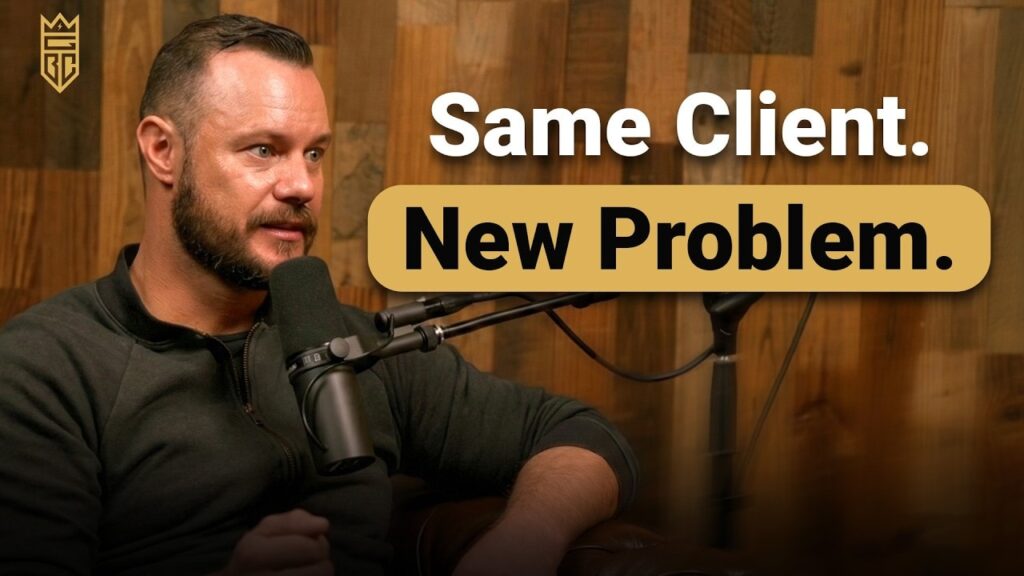
"The client you're coaching today isn't the same person who signed up six months or a year ago."
"The client you're coaching today isn't the same person who signed up six months or a year ago."
That sentence nails the core issue. People join to solve a specific problem: lose weight, gain energy, fit into clothes. Over time that problem changes - their body adapts, their goals shift, their schedule changes, or their fitness baseline improves. If your gym-business continues to treat them as a day-one prospect, they will reach a plateau and then leave.
Ascension is not upsell for the sake of revenue. It is an ongoing answer to the question: what does this evolving client need next? If you can supply the next correct program, service, or touchpoint, retention improves dramatically.
Systems replace good intentions
Good intentions do not scale. A coach's enthusiasm or an owner's promise will not prevent the same churn patterns from repeating. Systems do. A system is simply a repeatable, documented process - whether it's an email sequence, a text follow-up, a scripted consultation, or a staff onboarding checklist.
When a problem occurs, the goal is to solve it once and bake that solution into your gym-business. Doing so prevents you from re-experiencing the same pain over and over.
What "solve it once" looks like
- Identify the specific failure point (e.g., members churn at week six).
- Design a repeatable intervention (e.g., week-five coaching check-in, nutrition tweak, or small group invite).
- Automate and document the intervention, so any staff member can apply it.
- Measure outcomes, tweak, and lock the process into the gym-business playbook.
Use data to find the real problems
When clients fall off, many gym-business owners respond emotionally: "We need more marketing" or "We need better staff." The smarter response is to let the data tell you which part of the journey is breaking.
Look at the numbers:
- Where are the biggest drop-offs? Lead>book>show>convert>retain
- Which days or weeks see higher churn?
- Which staff members have higher retention rates and what do they do differently?
- What is the lifetime value (LTV) across product types?
Once you can point to the bottleneck inside the gym-business operating system, you can focus your energy on fixing that hole instead of guessing.
Attraction: more than just lead volume
Many gyms chase more leads thinking volume will solve everything. But quality and fit matter. If your gym-business has great lead flow but weak conversion, the problem may be messaging (wrong audience), or conversion (sales conversation).
Ask these questions:
- Are the leads matching the client profile you succeed with?
- Does your marketing message clearly filter out poor fits and attract ideal prospects?
- Are you tracking which campaigns bring the best LTV?
Successful gym-business attraction systems are engineered to attract fewer but better clients. That reduces friction later and makes the conversion and ascension systems more effective.
Conversion: design for every booking outcome
Conversion is not a single event; it's a funnel with multiple interactions. Build scripts and sequences for each common event:
- No-shows: automated text, friendly voice follow-up, and a rebooking path.
- Last-minute cancellations: immediate reschedule offer plus an incentive.
- Hesitant prospects: timed nurture sequence with social proof and smaller commitment options.
The consultation itself should be a systemized conversation. Use a consistent checklist so you can measure which parts of the conversation predict conversion. That gives you the power to coach staff and improve the process.
When conversions drop, don't assume marketing is the problem
If conversions decline while lead volume is healthy, investigate the consultation process. Are staff following the script? Are you qualifying prospects early? Are you honest about fit? A gym-business that can say "no" to poor fits gains long-term stability.
Delivery: support clients beyond early momentum
Early wins are easy to engineer. The hard part is sustaining progress. Delivery systems should anticipate plateaus and breakpoints.
Examples of delivery systems:
- Program progressions mapped for months, not weeks.
- Automated check-ins at known plateau times.
- Mini-challenges or educational sequences to re-engage attention.
- Hybrid touchpoints: combine digital tracking with one-on-one or small-group coaching.
Design your delivery so it evolves with the client. The gym-business that keeps people long-term treats coaching as a lifecycle, not a six-week sprint.
Ascension: follow the problem to its next form
Ascension is answering the question: once we solve the present problem, what is next? A client's needs will change from fat loss to strength to athletic performance, or from accountability to community . Build clear pathways that guide members to the next appropriate product or service.
Ascension systems include:
- Tiered programs that map to skill and commitment levels.
- Specialty offers (nutrition coaching, small-group training, personal training) timed to when members plateau.
- Retention checklists that shift members into maintenance or advanced tracks.
When the gym-business anticipates a new problem and offers the next solution, members stay engaged and revenue per member increases.
Staff journeys matter as much as client journeys
Everything that applies to clients applies to staff. Document the staff journey from recruitment to onboarding, to development. If staff churn is a problem, the root cause might not be hiring; it might be poor onboarding, lack of role clarity, or unclear performance metrics.
Build a staff operating system:
- Clear job descriptions that match reality.
- Onboarding checklists with milestones and check-ins.
- Training templates for sales, delivery, and client care.
- Career paths and review cadences tied to KPIs.
A gym-business with stable staff reduces disruption, protects culture, and scales predictably.
Common gym-business pitfalls and how to avoid them
Here are recurring mistakes gym-businesses make and the exact system fixes that stop the cycle.
- Pitfall: Chasing volume when the real problem is conversion. Fix: Map the conversion process, script the consultation, and track conversion metrics to identify leaks.
- Pitfall: Treating retention as a motivational issue. Fix: Map client plateaus and create timed interventions (check-ins, nutrition resets, new programming).
- Pitfall: Running short-term offers that end without continuation. Fix: Design offers with clear next steps: an evergreen pathway that transitions clients from short-term challenges to ongoing membership.
- Pitfall: Solving problems emotionally, not systematically. Fix: Document solutions, automate where possible, and require staff to follow the process.
- Pitfall: Not tracking the right numbers. Fix: Track booking rate, show rate, conversion rate, churn timing, LTV, and staff-level retention metrics.
Fix: Map the conversion process, script the consultation, and track conversion metrics to identify leaks.
Fix: Map client plateaus and create timed interventions (check-ins, nutrition resets, new programming).
Fix: Design offers with clear next steps: an evergreen pathway that transitions clients from short-term challenges to ongoing membership.
Fix: Document solutions, automate where possible, and require staff to follow the process.
Fix: Track booking rate, show rate, conversion rate, churn timing, LTV, and staff-level retention metrics.
Short-term offers vs evergreen journeys
Six-week challenges are popular because they promise fast results. But they create an artificial end point. If your gym-business relies on offers with built-in expiration, you will see spike-and-churn behavior unless you design a follow-up journey.
Prefer models that create continuous journeys, such as semi-private or membership-based programs, where the lifecycle is evergreen. In an evergreen gym-business model, there is no hard end point - only transitions. This reduces churn and increases lifetime value.
Build the smallest repeatable systems first
When systems feel overwhelming, start small. You do not need to document and automate everything at once. Pick the one place where you leak the most value and fix it first. Common starting points for a gym-business:
- Fix the consultation script and follow-up sequence.
- Create a no-show recovery flow that rebooks automatically.
- Implement a week-five check-in for new members.
- Build an exit survey and a cancel-and-revive sequence for canceled members.
Each small system you install decreases firefighting and creates more capacity for growth work.
How to measure whether your gym-business systems are working
After installing systems, measure results using these KPIs:
- Booking rate: Leads → booked consultations.
- Show rate: Booked → attended consultations.
- Conversion rate: Consultations → new members.
- Churn timing: When members cancel relative to start date.
- LTV: Average revenue per member over time.
- Net promoter score: Member satisfaction and referrals.
Use the baseline numbers to create targets. The value of a system is that it creates a baseline for measurement. If you can test one variable at a time, you can identify what works and scale it across your gym-business.
Example: turning a no-show into a rebooked member
Here's a simple rebooking system that converts no-shows into members:
- Immediately send an empathetic text: "No worries - things happen. Want to reschedule? Here's a link."
- If no response within 12 hours, send a reminder with social proof and an easy booking link.
- Make a phone call within 48 hours if still no response, using a script that normalizes no-shows and offers helpful next steps.
- If they ask to be followed up later, schedule an automated follow-up for the requested date.
Document this system, automate the first two steps, and train staff on the call script. The gym-business that follows this process will recover many prospects that otherwise would disappear.
How to prioritize which gym-business systems to build first
Prioritization should be driven by impact and frequency. Ask three questions for each problem you encounter:
- How often does this happen?
- What is the financial cost when it happens?
- How much effort will it take to build a repeatable solution?
Work on the highest-frequency, highest-cost, lowest-effort wins first. Those create momentum and free up time to address bigger, more complex problems.
Culture: the glue that makes systems work in your gym-business
Systems rely on people to execute. Build a culture that values adherence to process and continuous improvement. Reward staff for following documented systems and for suggesting improvements backed by data.
When your gym-business treats systems as sacred, you stop reinventing the wheel and start compounding small wins into dramatic outcomes.
A simple 90-day action plan for your gym-business
Follow this 90-day plan to get systems off the whiteboard and into daily operations:
- Week 1: Map your client journey from lead to churn. Identify the top three leak points.
- Week 2-3: Pick one leak point and design a small repeatable process to address it (script, email, text, checklist).
- Week 4: Automate the low-effort parts and document every step.
- Week 5-8: Train staff to follow the process and collect data.
- Week 9-12: Measure results, iterate, and lock the process into the playbook. Move to the next leak point.
Repeat this cycle. Over a few quarters your gym-business will transform from reactive to proactive.
Final thoughts: build the infinity loop
Your gym-business thrives when you stop thinking of client relationships as transactional and start thinking in cycles. Attraction, conversion, delivery, and ascension form an infinity loop. Each time you identify a fracture and install a system, the loop tightens and your business becomes more predictable.
Systems are the difference between a gym-business that limps along and one that scales. They free you from putting out fires, reduce churn, increase lifetime value, and make the daily work more enjoyable.
Checklist: quick wins to implement this week
- Create a no-show recovery text and automate it.
- Add a week-five member check-in for new clients.
- Document your consultation flow in five bullet points.
- Set up a cancel-and-revive email sequence.
- Start tracking churn timing so you know when the common failure points occur.
If you implement these small systems and stick to them, your gym-business will stop repeating the same breakdowns. Systems do not remove work - they create leverage. The result is more revenue, less burnout, and a better experience for everyone involved.
One-line reminder
Treat each client as a moving target: map the possible journeys, build the systems to handle them, and measure what changes.
Your gym-business is only as strong as the systems you've committed to. Start small, measure, and iterate. The compounding effect will surprise you.
Related Posts
- Gym-Business, Fitness-Business, Gym-Owner Strategy: Why Your Model Is Already Behind (and What Wins Next)
- Gym Business Reality Check: Why CrossFit's Decline Is a Wake-Up Call and the New Game Plan
- Why Most Gym Owners Fail (And The Data That Proves It) - gym business coach, fitness business,
Further Reading: The Ultimate Guide to Scaling a Gym Business
About the Author
Tim Lyons
Tim Lyons is a 17-year gym owner, CEO of Gym Business Coach, and founder of Iron Circle - the private mastermind for serious gym owners. He is the author of the Built series and has helped thousands of gym owners across North America build profitable, scalable fitness businesses.
Springboard Program Iron Circle Mastermind
Continue learning
Pricing and Profitability
Explore more Gym Business Coach strategies on this operating topic.
Explore this topic →
GYM BUSINESS COACH TEAM
The Gym Business Coach Team helps gym owners build more profitable, scalable businesses through coaching, masterminds, and live events. 2,500+ gym owners coached across North America. Learn more at ironcircle.net.